A morning on the beech

beech seeds chuck them now
A handful of power

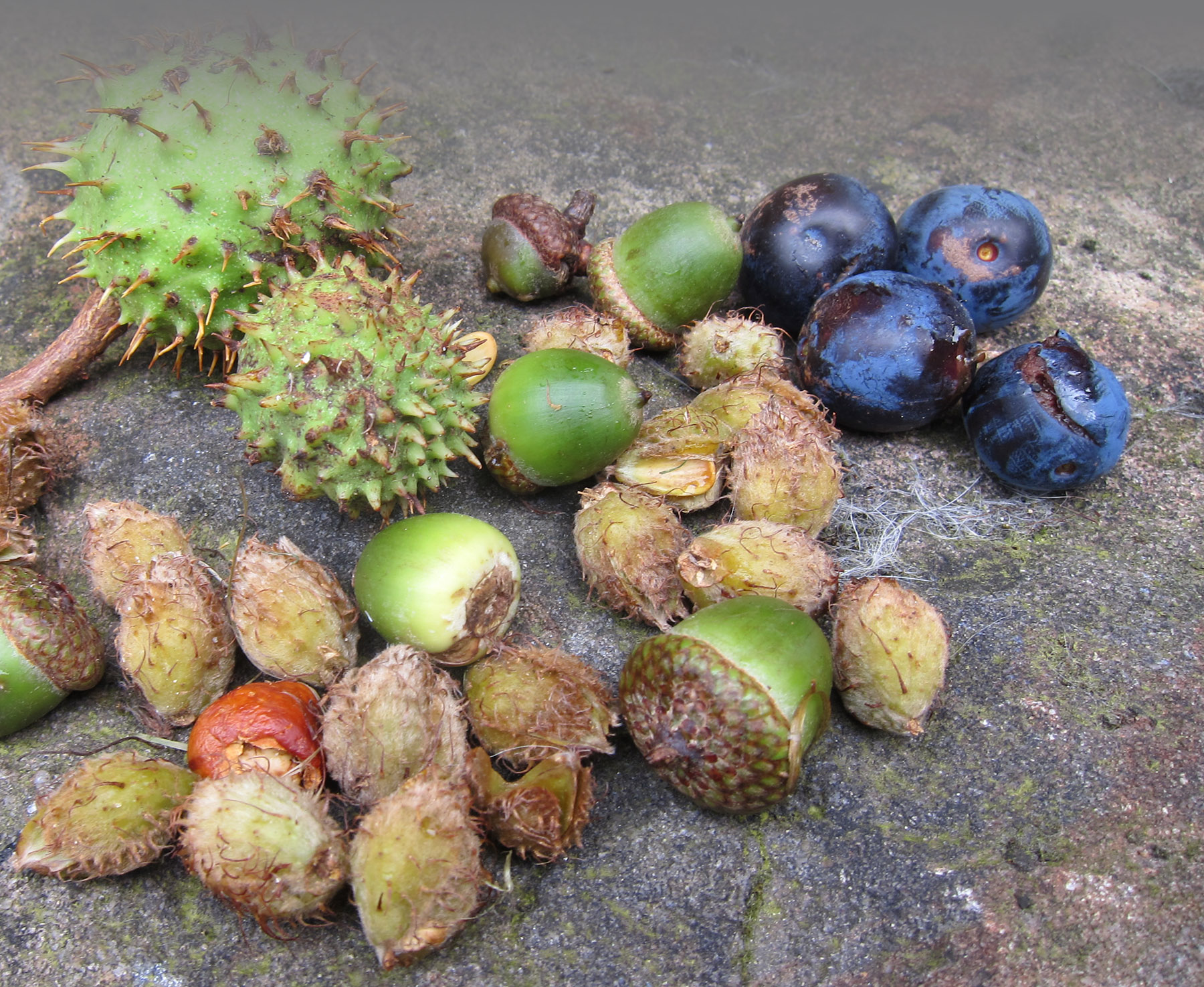
The beech is a stupendous tree. It can achieve huge height and girth, its canopy creating a particular light and atmosphere; yet its seeds are small. Because they tend to fall out of the pod holding them they can be time-consuming to gather, and especially hard on earth under a tree. Pavements and park paths are a more efficient place to gather a lot of seeds, so I had got some there several times by brushing the pods aside with my fingers, then collecting the seeds underneath. This works, but I started to think that a wholesale approach would work better, and it is necessary to get a shift on before they get washed away or disappear under leaf fall, which will happen at the first frost.

beech seed collection
Going for quantity

So, for the first time the shovel came out. Brushing together a big pile, pods and all, then shovelling the lot into sacks my mate Sarah and me made rapid inroads, filling 5 0r 6 bags in short order. I had spotted an old quarry near the road which was unused and fenced off so the sheep can’t get in. It had grassed over, with signs of a camper’s fire and beer cans. We climbed to the rim and began throwing, the stiff wind whipping away the seeds and leaves. We grinned at each other for the exhilarating, elemental joy of it. We split up and worked our way around the small, complex area and with the amount we had, managed to cover a surprising area.

seedrunners uk beech seeds scattering
That’s more like it: Sarah on the case

We had also gathered some horse chestnuts, perhaps the most beautiful seed with its sumptuous colour, hand-nestling form and its association with childhood conker battles. Not many seem to do that any more, otherwise there would not have been so many left on the pavement. Childhood’s loss is the seed chucker’s gain. A woman running past stopped to chat, and said that she keeps chestnuts around the house on the advice of a friend to keep away spiders. She claims it works. The Wikipedia page on them says that they contain alkaloid saponins (well obviously), but there is no evidence for its affect on spiders. Many things will turn out out to be true once evidence is bought and sought, but I for one don’t want researchers to carefully poison spiders to find out.

A sign of changing childhood - conkers ignored on a school route
A sign of changing childhood – conkers ignored on a school route

It takes more time, but we decided to dib the chestnuts into the turf, making a hole through the grass with our fingers,then pushing the seed in until it seemed to be in contact with the ground. It seems more worth it with a big seed for some reason. Will this give it a better chance? Not knowing is fine. Maybe the mice whose holes were everywhere will just have a good feast, or maybe the fox, whose hole was below a small crag, will get them first. As Sarah said, “I’m looking forward to cycling past here in twenty years’ time, seeing trees and remembering this morning.” Time well spent.

The argument about whether the beech tree should be considered native to the north of England rather than just the south has been mentioned in parliament. This is probably due to it’s ability to shade out plants beneath it, though some rarer ones that can tolerate it thrive. It may have been introduced to the UK after the last glaciation period by Neanderthals  for its seeds, which can be fed to pigs or made into a kind of coffee.
http://en.wikipedia.org/wiki/Beech

Horse chestnuts are actually poisonous to some animals, though deer can eat them, are certainly bad for horses, and are not chestnuts. They are an introduced species native to the Balkans and naturalised to the UK since the 1600s, mainly in parks, but are a good pollen source for bees. They were used (unsuccessfully)  in the First and Second World Wars as a non-food source of starch in the production of cordite for armaments
More on horse chestnut trees: http://en.wikipedia.org/wiki/Aesculus_hippocastanum
The game of conkers: http://en.wikipedia.org/wiki/Conkers

Fox at midday

Fox at midday seed runners


I walked past the garages and up the steep bank behind, which was bare a few years ago, but is now full of young birch and oak trees, some of which may have come from the acorns I dibbed into the ground years ago. Further round the hill the older parts of this small wood have huge oaks, hundreds of years old, which must have been there during the time of the coal mine, now filled in and overgrown. Though it is close to a built up area and main roads this small wood is enough to harbour deer, badgers, rabbits, a colony of crows and more. On our favourite picnic spot, a small heather-covered knoll with a view, last year a deer came close, staring at us as it chewed.

Below the same knoll today, by a stump raked with badger claw marks, was a flash of red against the lush grass.

Seedrunners fox marking its territory


It is a long time since I have seen a fox in the area, and see one so clearly was a real treat. It was upwind of me, so it was nonchalantly nosing around, then marking it’s territory with droppings which turned out to be full of fur and seeds – they will eat fruit like blackberries in autumn and therefore help to scatter the seeds. The area in the photo was full of droppings, and nearby were carcases of birds and a chicken. The crows will pick any bones they find clean, but will have to take care not to be caught while doing so.

Fox's meal: a chicken leg


I had set off to collect a few seeds, then run off somewhere and chuck them; there were no seeds or sign of acorns yet, though the holly berries were well on the way. But seeing the fox quieted and slowed me. I began picking up more detail instead: bulging fungi, mouse holes, the fox’s meals; then a rustle of leaves and a tawny owl hopped into view, glared at me appraisingly for a second before flying off to resume its sleep somewhere else.

Ted Hughes’s poem The Thought Fox

Cyclist in seed chucking shocker

Cyclist sewing tree seeds for habitat and carbon capture
Collect and throw on the go

Yes, modern cycling, it’s all about the right clothing, the equipment, the Strava segment, branded to the gills and eyes on the road, right? It’s now a bit more for this cyclist who loves all that, strong as hell on the hills, rides all day and all night and into the next day no problem, but also has eyes on the future too, the longer view, so he’s happy to make like the birds and the wind and  chuck a few seeds about as well. A five minute stop to fill a pocket with hawthorn seeds doesn’t hurt the training, and you don’t have to pause to scatter them, just throw them as far away from the roadside as possible. Good man. They’ll keep the wind off in a few years…

Cyclist collecting hawthorn seeds
All the best training allows for rest – gathering seeds takes about the right time

Were were on Hawthorns this day, which are a great habitat for small birds to nest in and feed from, masses of flowers for the bees in spring, and if you are so inclined Wikipedia has it you can eat the leaves when new as salad, and even the berries – I did not know that. They can hold their own against stock once established, and make a good windbreak, hence their common use in hedges and can tolerate relatively acidic soil. They are reputed to live up to 700 years. Now that’s what I call a PB.

For more on the common hawthorn see http://en.wikipedia.org/wiki/Crataegus_monogyna

Rowan

Rowan tree seeds_august_seedrunnerCollected and scattered some Rowan (Mountain Ash) berries today  – one of my favourite trees: loves the mountains, big bunches of blossom in the spring, blood-red berries in the autumn, there is a traditional Scottish song about it tha knows. Chuck ’em and gang hame ye glaekert wee peely-wally.

The Rowan Tree
Oh! Rowan Tree, Oh! Rowan Tree, thou’lt aye be dear to me,
Intwin’d thou art wi’ mony ties o’ hame and infancy.
Thy leaves were aye the first o’ spring, thy flow’rs the simmer’s pride;
There was nae sic a bonny tree, in a’ the countrie side.
Oh! Rowan Tree.

How fair wert thou in simmer time, wi’ a’ thy clusters white,
How rich and gay thy autumn dress, wi’ berries red and bright!
On thy fair stem were mony names, which now nae mair I see,
But they’re engraven on my heart — forgot they ne’er can be!
Oh! Rowan Tree.

We sat aneath thy spreading shade, the bairnies round thee ran,
They pu’d thy bonny berries red, and necklaces they strang;
My mother! oh! I see her still, she smiled our sports to see,
Wi’ little Jeanie on her lap, an’ Jamie at her knee!
Oh! Rowan Tree.

Oh! there arose my father’s prayer, in holy evening’s calm,
How sweet was then my mother’s voice, in the Martyr’s psalm!
Now a’ are gane! we meet nae mair aneath the Rowan Tree;
But hallowed thoughts around thee twine o’ hame and infancy.
Oh! Rowan Tree.

Carolina Oliphant  (1766-1845),